
Potato chips are one of the most popular snack foods worldwide, and their production has become highly industrialized. A complete potato chips production line consists of multiple machines working together—from raw potato handling to final packaging.
Understanding the full process and equipment involved is essential for building an efficient and profitable production line.
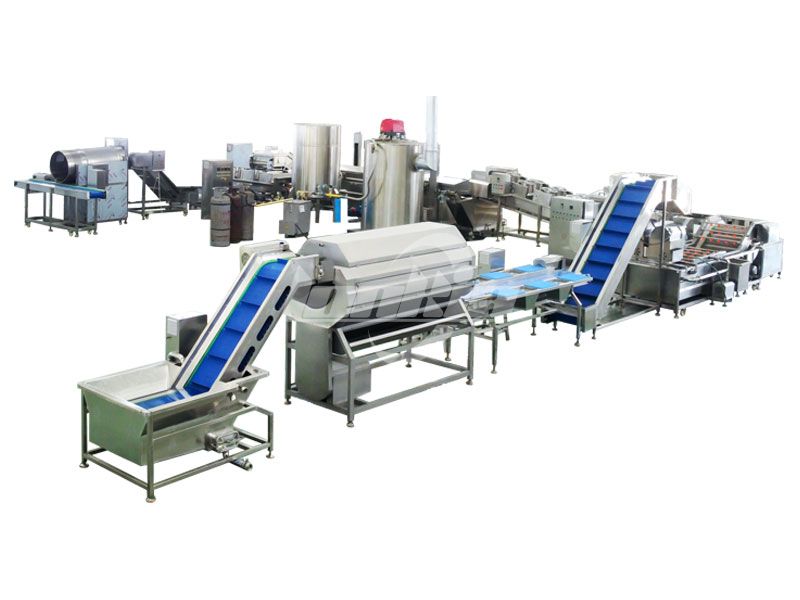
1. Complete Potato Chips Production Process
A standard potato chips production line typically follows this process:
Raw Material Handling → Peeling → Slicing → Washing → Blanching → Dewatering → Frying → De-oiling → Seasoning → Cooling → Packaging
Each step plays a critical role in ensuring product quality, texture, and consistency.
2. Key Equipment in a Potato Chips Production Line
① Potato Washing Machine
Function: Remove dirt, stones, and impurities
- Common types: bubble washer, brush washer
- Improves raw material cleanliness
② Potato Peeling Machine
Function: Remove potato skin
- Types: brush roller peeler / steam peeler
- Directly affects peeling loss and yield
③ Potato Slicing Machine
Function: Cut potatoes into thin slices
- Adjustable thickness (typically 1–2 mm)
- Determines chip texture and appearance
④ Washing Machine (Starch Removal)
Function: Remove surface starch
- Prevents slices from sticking
- Improves frying quality
⑤ Blanching Machine
Function: Heat treatment in hot water
- Inactivates enzymes
- Improves color and texture
⑥ Dewatering Machine
Function: Remove surface water
- Reduces oil consumption during frying
- Improves product quality
⑦ Continuous Fryer (Core Equipment)
Function: Fry potato slices
- Temperature: approx. 160–180°C
- Determines taste, color, and crispness
⑧ De-oiling Machine
Function: Remove excess oil
- Reduces oil content
- Improves product health profile
⑨ Seasoning Machine
Function: Add flavors
- Drum-type seasoning system
- Supports multiple flavors
⑩ Cooling Conveyor
Function: Cool down fried chips
- Prevents moisture buildup
- Maintains crispness
⑪ Packaging Machine
Function: Automatic weighing and packing
- Common setup: multihead weigher + packaging machine
- Ensures efficiency and consistency
3. Production Line Configurations by Capacity
✅ Small Scale Line (100–300 kg/h)
- Semi-automatic
- Lower investment
- Suitable for startups
✅ Medium Scale Line (300–1000 kg/h)
- Higher automation
- Best cost-performance ratio
- Most popular choice
✅ Large Scale Line (1000 kg/h+)
- Fully automatic
- Continuous production
- Suitable for industrial factories
4. Key Equipment Selection Tips
👉 Peeling Method:
- Brush peeling → lower cost
- Steam peeling → lower loss, higher quality
👉 Frying System:
Batch fryer → lower cost
Continuous fryer → higher efficiency (recommended)
👉 Automation Level:
- Small plants → semi-automatic
- Large plants → fully automatic
5. Conclusion
A well-designed potato chips production line should focus on:
✔ Efficient process flow
✔ Proper capacity matching
✔ Suitable automation level
The right configuration helps reduce labor costs, improve product quality, and maximize profitability.
LONKIA (Call to Action)
If you are planning to build a potato chips production line, LONKIA offers:
✔ Complete solutions from small to large scale
✔ Customized equipment configurations
✔ Factory layout design and quotation
👉 Contact us now to get a tailored production line solution for your project.