
Planning to start a frozen French fries business? One of the first questions to consider is how much a 500 kg/h French fries production line costs. A production line with a capacity of 500 kg per hour is a practical option for small and medium-sized food manufacturers, regional frozen food suppliers, and businesses looking to expand from fresh-cut fries into frozen products.
However, the total investment depends on more than the production capacity. The processing technology, automation level, equipment configuration, freezing system, packaging method, and factory conditions can all affect the final price.
This guide explains the main cost factors, the equipment required, and the additional expenses to consider when planning a 500 kg/h French fries production line.
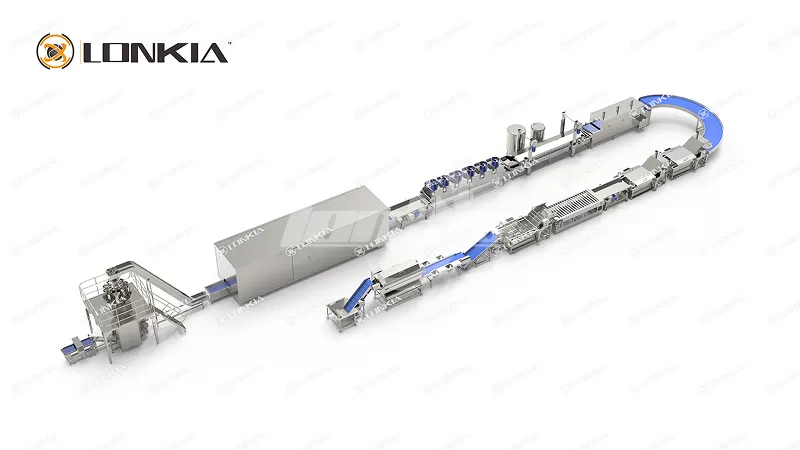
1. What Is the Cost of a 500 kg/h French Fries Production Line?
The cost of a 500 kg/h French fries production line varies depending on the scope of supply and the required level of automation. A line that includes only washing, peeling, cutting, and blanching will cost significantly less than a complete frozen French fries line with frying, freezing, and automatic packaging.
For preliminary budgeting, buyers should distinguish between three types of investment:
- Basic processing line: Covers essential potato preparation and processing equipment, with some downstream operations handled separately.
- Standard frozen French fries line: Includes the main processing stages, frying, cooling, freezing, and packaging equipment according to the selected configuration.
- Customized turnkey project: Includes a more integrated production system, customized conveying, automation, electrical controls, layout planning, installation, and commissioning services.
There is no single price that applies to every 500 kg/h project. The most reliable way to estimate the cost is to define the finished product, required output, processing method, and equipment scope first.
When requesting a quotation, confirm whether the quoted capacity refers to raw potato input or finished French fries output. This distinction is essential when comparing different suppliers.
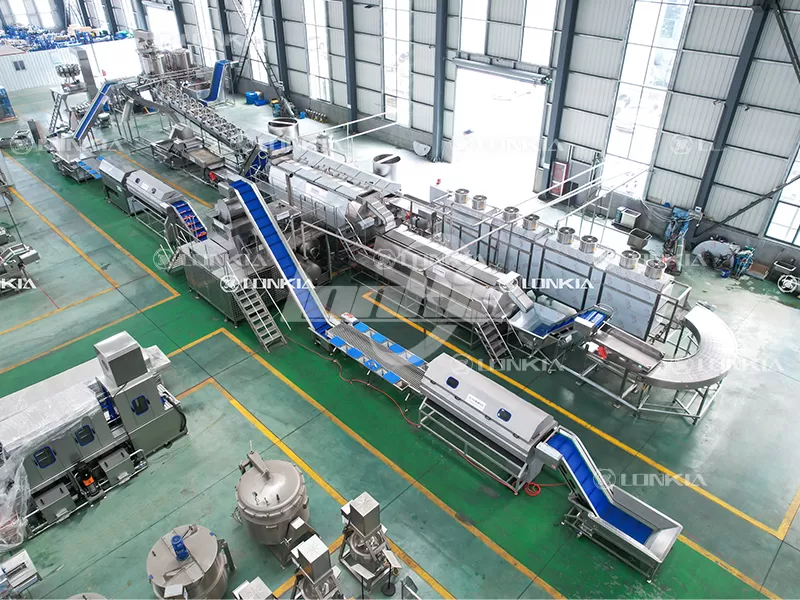
2. What Equipment Is Included in a 500 kg/h French Fries Production Line?
A frozen French fries production line typically includes several connected processing stages. Each stage contributes to the overall investment and determines the quality and consistency of the finished product.
2.1 Potato Washing and Peeling
The process starts with removing soil, stones, and other impurities from raw potatoes. Depending on the raw material and product requirements, the line may use a roller washer, brush washer, or other industrial washing equipment.
A peeling machine then removes the potato skin. Abrasive or roller peeling systems are common options, while steam peeling may be considered for projects that prioritize peeling efficiency and reduced product loss.
The choice depends on potato varieties, incoming potato condition, peeling requirements, and the available budget.
2.2 Potato Cutting
After peeling, potatoes are cut into strips using an industrial French fries cutting machine.
Common finished dimensions include 7 × 7 mm, 9 × 9 mm, and 10 × 10 mm, although other sizes can be produced by selecting suitable cutting blades.
Cutting specifications affect processing speed, frying time, texture, and finished-product appearance. If the factory plans to supply several customer segments, interchangeable cutting tools may be a worthwhile investment.
2.3 Blanching and Dewatering
Blanching is an important step in frozen French fries production. It helps control enzymatic activity, reduce excess surface starch, and prepare the potato strips for subsequent processing.
After blanching, the fries pass through a cooling and dewatering stage to remove excess water. Depending on the product specification, additional drying equipment may be installed before frying.
The blanching temperature, processing time, and moisture-removal method should be selected according to the potato variety and desired product quality.
2.4 Frying and Oil Management
For par-fried frozen French fries, a continuous fryer is typically used to achieve consistent color and texture at the required production rate.
The frying system may include automatic temperature control, oil circulation, filtration, and oil-level monitoring. Heating options can include electric heating, gas, diesel, or steam-based systems, depending on the equipment design and local energy supply.
The fryer and its supporting oil-management equipment can represent a significant part of the investment, especially when continuous operation and precise temperature control are required.
2.5 Cooling and Freezing
After frying, the French fries need to be cooled before entering the freezing stage.
An industrial individual quick freezing (IQF) system is commonly used to freeze the fries while helping prevent the strips from sticking together. Freezer capacity, inlet product temperature, target outlet temperature, and the required freezing time all affect the system design.
The refrigeration system is an important cost consideration. A complete freezing solution may require a freezer, refrigeration equipment, conveyors, and supporting electrical and control systems.
2.6 Weighing and Packaging
The final stage involves weighing and packing the frozen French fries into retail or food-service packages.
Depending on the sales model, packaging options may include semi-automatic weighing and bagging or a more automated system with multihead weighing, automatic bag forming, filling, and sealing.
A manufacturer supplying bulk frozen fries to restaurants and distributors may require a different packaging configuration from a factory producing small retail bags for supermarkets.
Packaging requirements should therefore be established early in the project.
3. What Factors Affect the Price?
Even when two production lines have the same nominal capacity, their prices can differ substantially. The following factors are particularly important.
| Cost factor | How it affects the investment |
|---|---|
| Processing scope | A partial line costs less than a complete frozen French fries line. |
| Automation level | Automatic feeding, conveying, controls, and packaging increase the initial investment but can reduce manual handling. |
| Frying system | Heating method, fryer design, oil filtration, and temperature control influence the cost. |
| Freezing capacity | Freezer type, refrigeration configuration, and required freezing performance affect the budget. |
| Material and construction | Stainless steel grade, equipment structure, and sanitary design requirements affect manufacturing costs. |
| Packaging system | Package size, weighing accuracy, bag type, and packing speed determine the required configuration. |
| Factory conditions | Existing utilities, available space, drainage, and installation requirements can add project costs. |
For example, a buyer who already owns a suitable industrial freezer may only need to invest in the upstream processing and frying equipment. Another buyer starting from an empty factory may need a complete solution, including refrigeration, packaging, and supporting systems.
Comparing quotations is meaningful only when the equipment scope and technical specifications are comparable.
4. Additional Costs Beyond the Equipment Price
The equipment quotation is only one part of the total project budget. Before placing an order, buyers should also evaluate the following expenses.
Factory building and preparation
The production area needs sufficient space for equipment, raw potato storage, finished-product handling, cleaning, and personnel movement. Food-grade floors, drainage, ventilation, and hygienic separation may require additional investment.
Utilities and energy supply
A French fries production line may require electricity, water, heating energy, compressed air, and refrigeration. The exact requirements depend on the selected machines and process design.
Installation and commissioning
Installation costs depend on the project location, equipment complexity, local labor availability, and the scope of supplier support. International projects may also involve travel, accommodation, and local engineering expenses.
Shipping, customs, and taxes
For imported equipment, buyers should account for international freight, insurance, customs duties, import taxes, and inland transportation.
Packaging materials and raw potatoes
A new factory needs an ongoing supply of suitable potatoes, frying oil, packaging materials, and other consumables. These are operating expenses rather than equipment investment, but they must be included in the business plan.
Maintenance and spare parts
Regular maintenance, replacement cutting blades, fryer components, conveyor parts, and refrigeration servicing should be considered when calculating long-term operating costs.
A useful budgeting approach is to separate the project into equipment investment, factory preparation, installation and logistics, and working capital. This provides a clearer picture of the actual funds needed to start production.
5. How Much Space Is Needed for a 500 kg/h French Fries Line?
The required factory area depends on the line layout, equipment dimensions, freezing system, storage facilities, and packaging arrangements.
A compact processing line with a limited equipment scope will generally require less space than a complete frozen French fries factory with raw material handling, frying, IQF freezing, and finished-product storage.
When planning the layout, consider four main areas:
- Raw material area: Potato receiving, temporary storage, and sorting.
- Processing area: Washing, peeling, cutting, blanching, dewatering, and frying.
- Freezing and packaging area: Cooling, IQF freezing, weighing, and packing.
- Storage and auxiliary area: Frozen-product storage, utilities, maintenance access, and cleaning facilities.
The layout should also allow workers to operate and maintain the machines safely. Adequate space around equipment is important for cleaning, inspections, and component replacement.
Before construction or renovation begins, request a preliminary equipment layout based on the actual factory dimensions and production requirements.
6. How Much Can a 500 kg/h French Fries Line Produce Per Day?
The theoretical output can be calculated by multiplying the production rate by operating hours.
For a line with a finished-product capacity of 500 kg/h:
| Operating time | Theoretical production |
|---|---|
| 4 hours/day | 2,000 kg/day |
| 8 hours/day | 4,000 kg/day |
| 10 hours/day | 5,000 kg/day |
| 16 hours/day | 8,000 kg/day |
These figures assume that 500 kg/h represents finished French fries output and that the line operates continuously at its rated capacity.
Actual production may be lower because of startup and shutdown time, product changeovers, cleaning, maintenance, raw potato quality, and production interruptions.
If 500 kg/h refers to raw potato input instead, the finished output will be lower because peeling, trimming, cutting, and processing result in product losses. Buyers should clarify this point before comparing production capacities or estimating revenue.
7. How to Reduce the Initial Investment Without Compromising Quality
For a new French fries business, controlling the initial investment is important. However, choosing the cheapest available machines does not always result in the lowest overall cost.
Here are several practical ways to optimize the project budget.
Start with your target market. Determine whether your customers need frozen par-fried fries, fully cooked fries, or fresh-cut potatoes. The processing requirements are different, and purchasing unnecessary equipment can increase costs.
Select an appropriate automation level. Some factories may start with semi-automatic packaging while automating washing, cutting, blanching, and frying. Automation can be expanded later as demand grows, provided the initial layout and equipment interfaces allow for future upgrades.
Match the equipment to actual capacity. Oversized equipment increases the initial investment and may create inefficient operating conditions. Undersized equipment can become a bottleneck that prevents the line from reaching its target output.
Evaluate energy consumption. Compare heating methods, insulation, water recycling options, oil filtration, and refrigeration efficiency. Energy and water consumption can have a significant effect on long-term operating costs.
Request an integrated layout. Coordinating the machines, conveyors, controls, and downstream equipment helps reduce unnecessary transfers and avoid costly modifications during installation.
Compare complete quotations. Check the included equipment, capacity definition, materials, electrical requirements, warranty, spare parts, installation support, and exclusions instead of comparing the total price alone.
8. Is a 500 kg/h French Fries Production Line Right for Your Business?
A 500 kg/h line may be suitable for a regional frozen food manufacturer, a growing food-processing company, or a business supplying restaurants, hotels, supermarkets, and food distributors.
Before choosing this capacity, consider the following questions:
- How many hours per day will the factory operate?
- Will the finished fries be sold frozen or fresh?
- What strip dimensions and finished-product specifications are required?
- Will the factory use automatic or semi-automatic packaging?
- Is an industrial freezer already available?
- What are the local electricity, water, and heating costs?
- Is there enough demand to support the planned production volume?
It is also worth checking whether the line can be expanded in the future. A well-designed production layout may allow additional packaging equipment, greater freezing capacity, or higher-throughput processing machines to be installed as the business grows.
9. Get a Customized Quote for a 500 kg/h French Fries Production Line
The cost of a 500 kg/h French fries production line depends on the actual production process, equipment configuration, automation requirements, and factory conditions. A basic processing setup and a complete frozen French fries production line are two very different investments, even when their nominal capacities are similar.
LONKIA provides customized food-processing equipment and production line solutions, from individual machines to integrated processing systems. Equipment configuration can be planned according to the target capacity, product specifications, available factory space, and project budget.
To receive a more accurate quotation, prepare the following information:
- Target capacity: 500 kg/h of raw potatoes or finished French fries.
- Product type: Frozen French fries or fresh-cut fries.
- Processing requirements: Whether frying, IQF freezing, and packaging are required.
- Automation level: Semi-automatic or fully automatic.
- Factory information: Available floor area and local utility conditions.
- Project location: Country and destination port or city.
With these details, the equipment scope can be defined more accurately, making it easier to estimate the investment and identify the most suitable production solution.
Contact LONKIA to discuss your 500 kg/h French fries production line project and request a customized equipment proposal.