
As demand for fresh-cut food products continues to grow, vacuum-packed fresh French fries are becoming increasingly popular among central kitchens, food processors, restaurant suppliers, and prepared food companies.
For businesses planning to invest in a fresh French fries processing project, one of the first questions is: How much does a vacuum packaging line for fresh French fries cost?
There is no single fixed price. The final investment depends on production capacity, processing requirements, automation level, packaging method, equipment configuration, and factory layout.
As a food processing machinery manufacturer, LONKIA designs fresh French fries processing solutions according to each customer's specific requirements. This guide explains what determines the price, what equipment is included, and how to choose the right production line for your project.
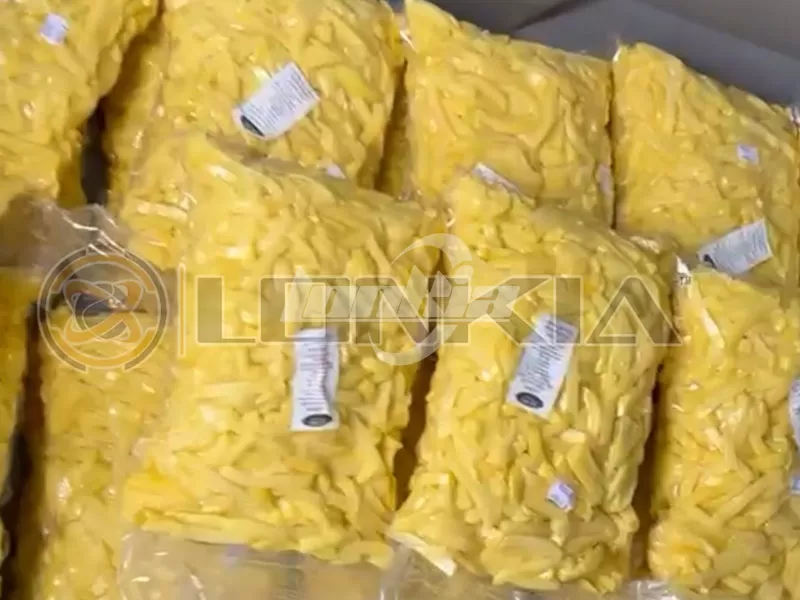
1. How Much Does a Vacuum Packaging Line for Fresh French Fries Cost?
The price of a vacuum-packed fresh French fries production line mainly depends on its capacity and configuration.
A small processing project may use a semi-automatic equipment combination, while a medium or large food factory may require continuous washing, peeling, cutting, soaking, dewatering, weighing, and vacuum packaging systems connected by conveyors.
Therefore, two projects that are both described as a "fresh French fries production line" can have very different investment costs.
Typical project configurations may include:
- Small or semi-automatic fresh French fries processing lines
- 500 kg/h fresh French fries lines
- 1,000 kg/h fresh French fries lines
- 2,000 kg/h and larger production lines
- Fully automatic fresh French fries processing and vacuum packaging lines
LONKIA does not use one fixed price for every production line. We configure the equipment according to the customer's actual production requirements.
When requesting a quotation, it is helpful to provide:
Target capacity + French fries size + package weight + processing requirements + automation level
With this information, LONKIA can recommend suitable equipment and provide a more accurate quotation.
2. What Equipment Is Included in a Fresh French Fries Vacuum Packaging Line?
A complete fresh French fries processing line is normally made up of several processing stages.
A typical process is:
Potato Feeding → Washing → Peeling → Sorting → Cutting → Soaking/Color Protection → Dewatering → Weighing → Vacuum Packaging → Refrigeration
The exact configuration can be customized according to the product and production requirements.
2.1 Potato Washing Machine
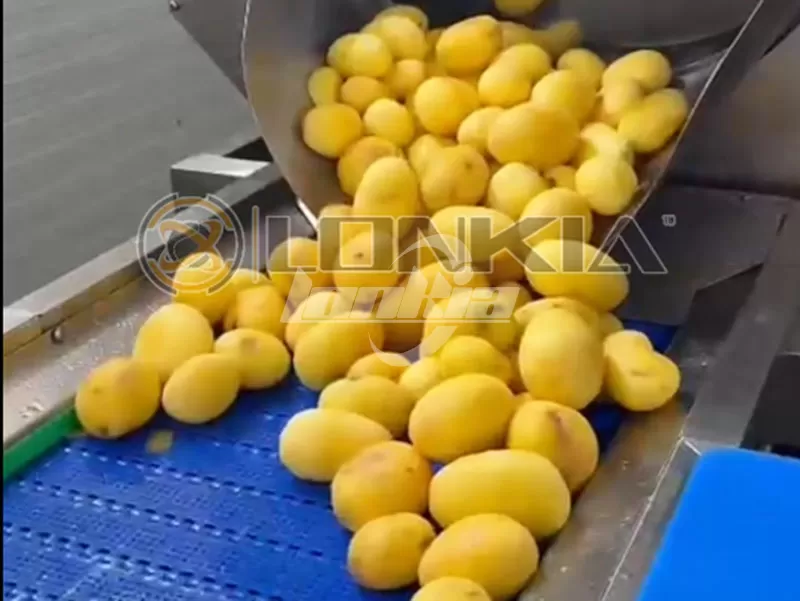
The first step is to remove soil, sand, and other impurities from the potatoes.
Depending on the raw material and required capacity, different industrial potato washing systems can be selected to achieve continuous processing.
2.2 Potato Peeling Machine
After washing, the potatoes enter the peeling process.
LONKIA can configure suitable industrial potato peeling equipment according to the potato variety, processing capacity, and peeling requirements.
2.3 Sorting Conveyor
A sorting conveyor can be installed after peeling so operators can inspect the potatoes and remove damaged or unsuitable raw materials.
For medium and large processing lines, the sorting station can be integrated with the continuous conveying system to improve production efficiency.
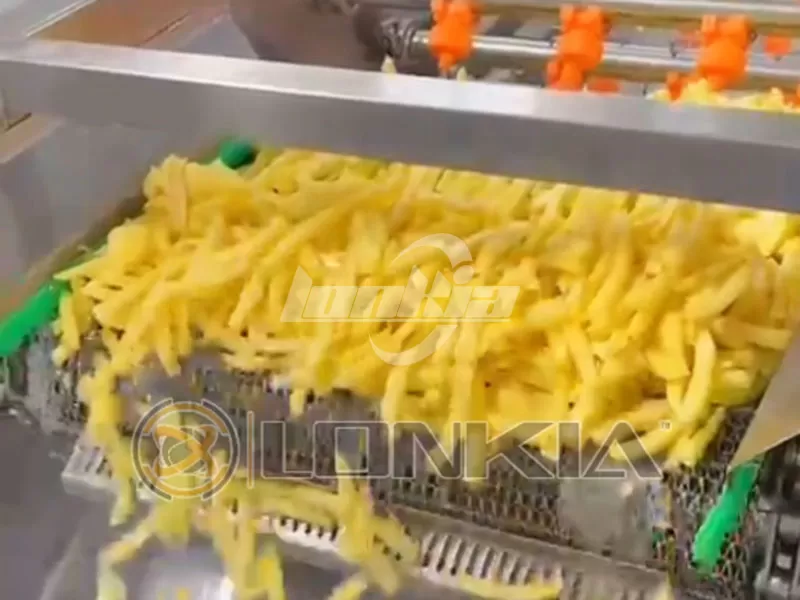
2.4 French Fries Cutting Machine
Cutting is one of the key processes in fresh French fries production.
Different knife sets can be used to produce different French fries sizes, such as 7×7 mm, 10×10 mm, or customized sizes.
If your products require several French fries specifications, the knife configuration and changeover method should be confirmed during the project design stage.
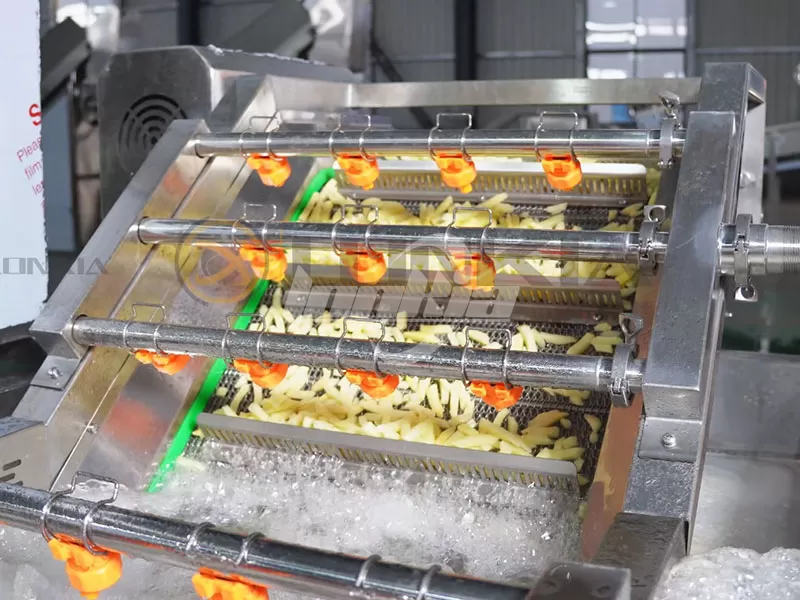
2.5 Soaking and Color Protection System
After cutting, freshly cut potatoes can change color when exposed to air for an extended period.
Depending on the product requirements, soaking and color protection processes can be incorporated into the production line.
The exact process should be determined according to the potato variety, product requirements, storage time, and applicable food processing standards.
2.6 Dewatering Machine
After washing or soaking, water may remain on the surface of the French fries.
A dewatering system can remove excess surface water and improve the efficiency of subsequent weighing and packaging.
2.7 Automatic Weighing System
For fixed-weight packages such as 500 g, 1 kg, or 2 kg, an automatic weighing system can be integrated into the line.
Automatic weighing reduces manual portioning and improves package weight consistency.
2.8 Vacuum Packaging Machine
The vacuum packaging machine is an important part of the downstream process.
It removes air from the package and seals the bag to create a closed package.
However, vacuum packaging does not mean that fresh French fries can be stored at room temperature for a long period.
Fresh-cut French fries normally require appropriate refrigeration and cold-chain handling. The actual shelf life and storage conditions depend on the processing method, packaging material, hygiene conditions, and storage temperature.
3. What Factors Affect the Price of a Fresh French Fries Production Line?
Why can quotations from different suppliers vary significantly?
Several factors affect the final cost.
3.1 Production Capacity
Capacity is one of the most important pricing factors.
A 500 kg/h line and a 2,000 kg/h line require different equipment sizes, conveying capacities, and automation systems.
When requesting a quotation, make sure to clarify:
Does the stated capacity refer to raw potato input or finished French fries output?
Different suppliers may use different capacity definitions.
3.2 Automation Level
Semi-automatic and fully automatic production lines have different costs.
A semi-automatic line requires more manual operations, such as feeding, sorting, weighing, or packaging.
A fully automatic line can connect multiple processing stages through conveyors and automated systems, reducing labor requirements.
For factories running continuously or multiple shifts per day, a higher level of automation may provide better long-term efficiency.
3.3 Processing Technology
Different customers require different processing steps.
Some projects may only require:
Washing → Peeling → Cutting → Packaging
Other projects may require:
Washing → Peeling → Cutting → Soaking → Color Protection → Dewatering → Weighing → Vacuum Packaging
The number and type of processing stages directly affect the equipment configuration and total investment.
3.4 Packaging Method
Packaging requirements also influence the equipment configuration.
Common package sizes include:
- 500 g per bag
- 1 kg per bag
- 2 kg per bag
- 5 kg per bag
If automatic weighing, bag feeding, or continuous vacuum packaging is required, additional equipment may be necessary.
3.5 Equipment Material and Electrical Configuration
Food processing equipment needs to meet requirements for hygiene, safety, durability, and corrosion resistance.
LONKIA can manufacture food processing equipment using food-grade stainless steel and configure electrical systems according to the customer's requirements and local standards.
PLC systems, electrical components, control methods, and other specifications can also be discussed during the project design stage.
3.6 Factory Layout
The factory layout can also affect the final production line design.
Even with the same equipment, the conveyor length and equipment arrangement may be different depending on the available factory space.
When designing a complete line, LONKIA considers:
- Factory dimensions
- Raw material entrance
- Finished product exit
- Water and power supply
- Equipment maintenance space
- Operator access
- Production flow
This helps create a practical and efficient production layout.
4. How Do You Choose the Right Production Capacity?
Before selecting equipment, we recommend determining the actual production demand rather than simply choosing the largest possible capacity.
100–300 kg/h
Suitable for smaller food processing businesses or regional supply projects.
A semi-automatic configuration can provide flexibility while keeping the initial equipment investment under control.
500–1,000 kg/h
Suitable for medium-sized food processors, central kitchens, and regional food suppliers.
A continuous processing system with automatic conveying and weighing can improve production efficiency.
1,000–2,000 kg/h
Suitable for larger food processing businesses with stable orders.
A more complete continuous processing solution can reduce manual operations and improve production consistency.
Above 2,000 kg/h
Suitable for large-scale food factories and high-volume fresh French fries projects.
These projects normally require customized engineering based on factory size, product specifications, daily production targets, and downstream packaging and refrigeration requirements.
LONKIA designs the equipment configuration according to the required capacity rather than applying the same equipment package to every project.
5. What Is the Difference Between Vacuum-Packed Fresh French Fries and Frozen French Fries?
This is an important question when planning a French fries processing project.
Vacuum-Packed Fresh French Fries
A typical process is:
Washing → Peeling → Cutting → Soaking/Color Protection → Dewatering → Weighing → Vacuum Packaging → Refrigeration
The process is relatively simple and does not require a large freezing system.
This solution can be suitable for:
- Central kitchens
- Restaurant supply companies
- Fresh-cut food processors
- Regional food distributors
- Fresh French fries suppliers
Frozen French Fries
A typical process is:
Washing → Peeling → Cutting → Blanching → Dewatering → Pre-Frying → Oil Removal → Freezing → Packaging
Frozen French fries normally require additional processes such as blanching, pre-frying, and IQF freezing.
As a result, the equipment configuration, investment, factory requirements, and utilities can be significantly different.
If your target product is refrigerated vacuum-packed fresh French fries, there is normally no need to install a complete frozen French fries production line.
LONKIA recommends the equipment based on the customer's final product and processing requirements, helping avoid unnecessary equipment investment.
6. What Information Should You Prepare Before Buying a Production Line?
To receive an accurate quotation, we recommend providing the following information.
6.1 Target Production Capacity
For example:
500 kg/h, 1,000 kg/h, or 2,000 kg/h
6.2 French Fries Size
For example:
7×7 mm, 10×10 mm, or another customized size
6.3 Package Weight
For example:
500 g, 1 kg, or 2 kg per bag
6.4 Product Type
Please specify whether you plan to produce:
Fresh French fries, refrigerated fresh French fries, or frozen French fries.
6.5 Automation Requirements
Let us know whether you prefer:
A semi-automatic or fully automatic production line.
6.6 Factory Information
If you already have a factory, providing the available:
Length, width, and height
as well as existing water, electricity, steam, and other utility conditions can help us design a more practical layout.
7. How Can You Reduce the Investment in a Fresh French Fries Production Line?
Reducing equipment investment does not necessarily mean choosing the cheapest machine.
A better approach is to make sure that the equipment configuration matches your actual production requirements.
Avoid Excessive Capacity
If your current demand is only 3 tons per day, purchasing a line designed for dozens of tons per day may create unnecessary capital and operating costs.
Select the Right Automation Level
For smaller production volumes, a semi-automatic solution may be sufficient.
For continuous production and multiple shifts, automated conveying, weighing, and packaging can help reduce labor requirements.
Optimize the Processing Flow
Not every customer needs exactly the same processing stages.
LONKIA evaluates the customer's final product and processing requirements before recommending the necessary equipment.
Evaluate the Complete Production Line
When comparing suppliers, do not look only at the price of an individual machine.
A better comparison includes:
Equipment performance + production capacity + energy consumption + labor requirements + after-sales support + service life
A machine with a lower initial price may not necessarily have a lower total cost over its operating life.
8. How Does LONKIA Design Fresh French Fries Production Lines?
As a food processing machinery manufacturer, LONKIA provides both individual machines and complete fresh French fries processing solutions.
Our project process generally includes:
Requirement Discussion → Process Design → Equipment Configuration → Production Line Layout → Equipment Manufacturing → Factory Testing → Installation & Commissioning → Technical Training
According to the project requirements, we can integrate washing, peeling, cutting, soaking, dewatering, weighing, vacuum packaging, and conveying equipment into a complete processing solution.
For different countries and production environments, equipment and electrical configurations can also be adjusted according to local standards and customer requirements.
9. Frequently Asked Questions
How much is a vacuum-packed fresh French fries production line?
There is no universal price.
The final cost depends on production capacity, equipment configuration, automation level, processing technology, and packaging requirements.
For an industrial project, we recommend determining the production requirements first and then requesting a customized quotation.
How much does a 500 kg/h fresh French fries production line cost?
Capacity alone is not enough to determine the final price.
The required washing, peeling, cutting, soaking, dewatering, weighing, and packaging processes must also be confirmed.
Can I purchase only part of the production line?
Yes.
If your factory already has some equipment, LONKIA can design a solution around your existing machines and supply the required processing modules.
Can LONKIA customize a fresh French fries production line?
Yes.
The production line can be customized according to production capacity, French fries size, processing technology, packaging requirements, factory layout, and automation level.
Do vacuum-packed fresh French fries need refrigeration?
Generally, yes.
Vacuum packaging does not replace refrigeration. The appropriate storage temperature and shelf life should be determined according to the actual processing method, packaging system, and product requirements.
10. Get a Quote for Your Fresh French Fries Production Line
If you are planning a fresh French fries processing project, we recommend choosing equipment based on your actual production requirements rather than comparing suppliers only by price.
A suitable production line should match your:
Production Capacity + Product Size + Processing Technology + Packaging Method + Factory Layout
LONKIA can provide customized fresh French fries processing equipment and complete production line solutions for food processing businesses.
To help us prepare a suitable solution, please tell us:
- What is your target production capacity?
- What French fries size do you need?
- What is the package weight?
- Do you need a semi-automatic or fully automatic line?
- Do you already have a factory?
Based on this information, LONKIA can recommend the appropriate equipment configuration and provide a customized technical solution and quotation.
LONKIA — Customized Food Processing Machinery and Complete Processing Solutions for Food Businesses.