
Have you ever wondered how fresh potatoes are transformed into crispy, evenly seasoned potato chips on an industrial scale?
A potato chip production line uses a series of connected machines to complete potato preparation, slicing, blanching, frying, seasoning, and packaging. Each stage plays an important role in controlling the quality and consistency of the finished chips.
The typical process is:
Potato Receiving → Washing → Peeling → Sorting → Slicing → Rinsing → Blanching → Dehydration → Frying → De-oiling → Cooling → Seasoning → Packaging
Let's look at how each step works.
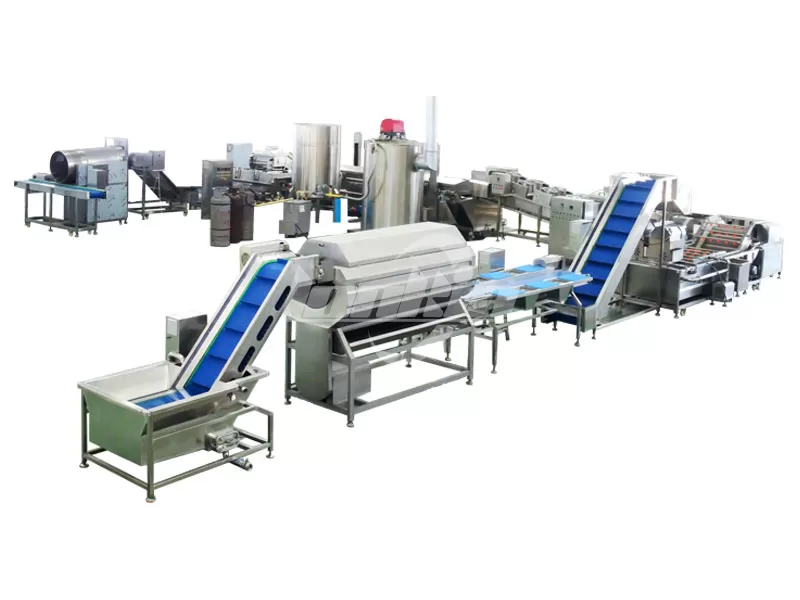
What Is a Potato Chip Production Line?
A potato chip production line is a combination of food processing equipment designed to continuously turn fresh potatoes into finished potato chips.
Instead of manually transferring potatoes between individual machines, conveyors connect the different processing stages. The equipment can also be configured according to the required capacity, processing method, factory layout, and automation level.
The basic workflow is:
Fresh Potatoes → Preparation → Slicing → Pre-treatment → Frying → Seasoning → Packaging
Step 1: Washing and Peeling
Fresh potatoes first enter the washing section, where soil, sand, and other surface impurities are removed.
After washing, the potatoes are peeled using an industrial potato peeling machine. Mechanical peeling systems remove the skin while aiming to minimize the loss of edible potato.
Proper washing and peeling provide clean and properly prepared potatoes for the next stage.
Main equipment: Potato Washer + Potato Peeling Machine
Step 2: Sorting and Inspection
After peeling, potatoes can pass through a sorting or inspection conveyor.
Damaged potatoes, remaining skin, dark spots, and other unsuitable material can be removed before slicing.
Consistent raw material helps improve the quality and stability of the finished potato chips.
Main equipment: Sorting Conveyor / Inspection Conveyor
Step 3: Potato Slicing
The prepared potatoes are continuously fed into an industrial potato slicer.
The slicer cuts the potatoes into thin slices with consistent thickness.
Why Is Slice Thickness Important?
Slice thickness directly affects frying performance. Uneven slices may fry at different speeds, resulting in inconsistent color and texture.
Therefore, a high-quality potato slicer is essential for stable industrial chip production.
Main equipment: Industrial Potato Slicing Machine
Step 4: Rinsing and Starch Removal
After slicing, the potato slices are rinsed to remove excess surface starch.
This step can help reduce sticking between slices and prepare the product for blanching and frying.
The rinsing system can be designed with continuous water flow and drainage according to the production requirements.
Main equipment: Potato Slice Rinsing System
Step 5: Blanching
The potato slices are then blanched in hot water under controlled conditions.
Blanching can help control enzymatic browning, modify starch characteristics, and improve color consistency before frying.
The slices are continuously fed into the blanching machine, treated for a controlled period, and then discharged to the next stage.
Main equipment: Continuous Blanching Machine
Step 6: Dehydration
After rinsing and blanching, the potato slices contain excess surface water.
Before frying, the slices are passed through a dewatering or drying system to remove surface moisture.
Controlling moisture before frying helps improve frying stability and can reduce unnecessary oil absorption.
Main equipment: Dewatering Machine / Air Drying System
Step 7: Frying
Frying is the core cooking stage of the potato chip production process.
The prepared slices enter a continuous fryer and are immersed in hot cooking oil for a controlled period.
During frying, moisture is removed and the potato slices develop their characteristic crispy texture and golden color.
What Affects Frying Quality?
Several factors need to be controlled:
- Slice thickness
- Frying temperature
- Frying time
- Initial moisture
- Oil condition
A continuous fryer can integrate temperature control, oil circulation, filtration, and automatic conveying to maintain stable production.
Main equipment: Continuous Potato Chip Fryer
Step 8: De-oiling and Cooling
After frying, the chips contain surface oil. A de-oiling system removes excess oil before the chips move to the seasoning stage.
The chips are then cooled using a cooling conveyor or air-cooling system.
Cooling helps stabilize the product and prepares it for seasoning and packaging.
Main equipment: De-oiling Machine + Cooling Conveyor
Step 9: Seasoning
The cooled potato chips enter the seasoning machine.
The chips are gently tumbled while seasoning is added, helping distribute flavor evenly across the product.
Common seasoning options include:
- Salt
- Barbecue
- Cheese
- Chili
- Sour cream and onion
The seasoning dosage can be adjusted according to the product requirements.
Main equipment: Potato Chip Seasoning Machine
Step 10: Weighing and Packaging
The final step is packaging.
Finished chips are conveyed to an automatic weighing and packaging system. The machine weighs the product, fills the bags, and seals them.
Packaging helps protect potato chips from moisture and the external environment, helping maintain their crispness and freshness.
Main equipment: Automatic Weighing & Packaging Machine
Complete Potato Chip Production Line Equipment
| Processing Stage | Main Equipment |
|---|---|
| Washing | Potato Washing Machine |
| Peeling | Potato Peeling Machine |
| Sorting | Sorting Conveyor |
| Slicing | Potato Slicing Machine |
| Rinsing | Rinsing System |
| Blanching | Blanching Machine |
| Dehydration | Dewatering Machine |
| Frying | Continuous Fryer |
| De-oiling | De-oiling Machine |
| Cooling | Cooling Conveyor |
| Seasoning | Seasoning Machine |
| Packaging | Packing Machine |
The exact equipment configuration can be customized according to the target capacity, product requirements, and factory layout.
How Do All the Machines Work Together?
A potato chip production line works as a continuous system rather than a group of independent machines.
For example:
Washing → Slicing → Blanching → Dehydration → Frying → Cooling → Seasoning → Packaging
Each stage prepares the potatoes for the next one.
Equipment capacity also needs to be properly matched. If one machine has significantly lower capacity than the others, it can become a production bottleneck.
For larger factories, PLC control, automatic conveyors, temperature monitoring, and other automation systems can be integrated to improve production consistency.
What Affects Potato Chip Quality?
The quality of finished potato chips depends on several factors:
- Raw potato quality
- Slice thickness
- Starch removal
- Blanching conditions
- Moisture before frying
- Frying temperature
- Frying time
- Oil quality
- Seasoning dosage
- Packaging conditions
This means that consistent potato chips are the result of properly controlling the entire production process, not just the frying stage.
How to Choose a Potato Chip Production Line?
Before selecting equipment, manufacturers should consider:
1. Production Capacity
Determine how many kilograms of fresh potatoes you need to process per hour.
2. Product Requirements
Consider chip thickness, flavor, frying method, packaging format, and other specifications.
3. Automation Level
Choose between semi-automatic and fully automatic configurations according to labor availability and production requirements.
4. Factory Layout
The equipment and conveyors should be arranged according to the available production space and material flow.
5. Equipment Integration
The capacity and operation of each machine should be matched to create a stable and continuous production process.
Frequently Asked Questions
What machines are needed to make potato chips commercially?
A typical line includes a potato washer, peeling machine, slicer, rinsing system, blanching machine, dewatering machine, fryer, de-oiling machine, cooling conveyor, seasoning machine, and packaging machine.
Why are potato slices blanched before frying?
Blanching can help control browning and starch characteristics while preparing the slices for frying.
Why are potato slices dehydrated before frying?
Dehydration removes excess surface water and helps improve frying stability.
Can a potato chip production line be customized?
Yes. The line can be configured according to production capacity, potato characteristics, processing requirements, factory layout, and automation level.
Conclusion
A potato chip production line transforms fresh potatoes into finished chips through a series of controlled processing stages:
Washing → Peeling → Slicing → Rinsing → Blanching → Dehydration → Frying → De-oiling → Cooling → Seasoning → Packaging
The key to efficient production is coordinating every stage and matching the capacity of each machine.
LONKIA provides potato chip processing machines and complete production line solutions, from individual equipment to customized automated lines. If you are planning a potato chip production project, tell us your target capacity, product requirements, and factory layout, and our technical team can help design a suitable solution.