
If you are planning to purchase an industrial potato cutting machine, price is usually one of the first factors to consider. However, the cost of a potato cutter can vary significantly depending on the machine type, cutting capacity, configuration, automation level, and customization requirements.
For food processing factories, choosing a machine based only on the lowest price can lead to higher operating and maintenance costs later. In this guide, LONKIA explains the main factors that affect the price of an industrial potato cutting machine and how to choose the right equipment for your production.
How Much Does an Industrial Potato Cutting Machine Cost?
The price of an industrial potato cutting machine can range from several thousand to tens of thousands of US dollars, depending on the configuration and production capacity.
A small-capacity industrial cutter may be suitable for relatively limited production, while a high-capacity automatic potato cutting machine designed for a French fries or potato processing line will require a larger investment.
The following factors have the greatest impact on the final price:
- Machine capacity
- Cutting type and size
- Automation level
- Machine material
- Feeding and discharge configuration
- Motor and electrical components
- Customization requirements
- Integration with a complete processing line
Therefore, there is no single standard price for every industrial potato cutter.
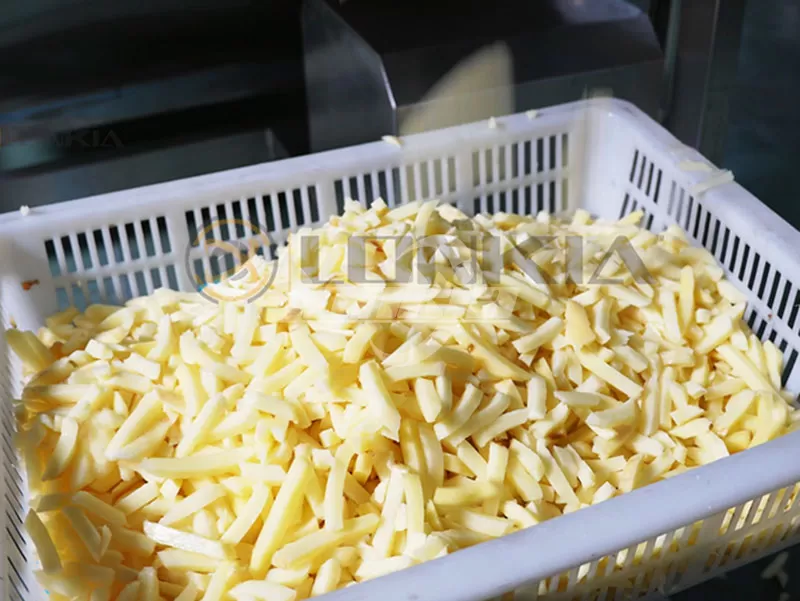
1. Production Capacity
Capacity is one of the most important factors affecting the price.
A machine designed to process several hundred kilograms of potatoes per hour generally has a simpler structure than equipment designed for several tons per hour.
For example, a factory producing frozen French fries may require a potato cutter capable of continuous operation at 1,000–3,000 kg/h or more. Such equipment normally requires stronger motors, larger feeding systems, more durable cutting components, and a more robust stainless-steel frame.
Higher capacity usually means:
- Larger machine dimensions
- Higher motor power
- Stronger transmission components
- Higher cutting efficiency
- Greater production stability
As a result, high-capacity potato cutting machines generally cost more than lower-capacity models.
2. Cutting Type and Product Size
Different potato products require different cutting methods.
An industrial potato cutter may be configured for:
- French fries
- Potato strips
- Potato slices
- Crinkle-cut fries
- Potato cubes
- Other customized cutting shapes
The cutting system has a direct influence on machine cost. Different knives, cutting heads, and configurations may be required for different product specifications.
For example, a French fries production line may require a specialized strip-cutting system capable of producing consistent dimensions, while a potato dicing application requires a different cutting mechanism.
If your factory needs several cutting sizes, the machine may also require interchangeable cutting components, which can increase the overall investment.
3. Automation Level
Automation is another important pricing factor.
A basic industrial potato cutter may require manual feeding and adjustment, while a complete automatic system can be integrated with conveyors, washing machines, peeling machines, blanchers, dryers, fryers, and other equipment.
An automated potato cutting system can provide advantages such as:
- Reduced manual labor
- More consistent production
- Continuous operation
- Easier production management
- Better integration with processing lines
Although a higher level of automation increases the initial equipment cost, it can reduce labor requirements and improve production efficiency in large-scale factories.
4. Stainless Steel Construction
For industrial food processing equipment, the material used in the machine is also important.
Food processing potato cutters are commonly manufactured with SUS304 stainless steel, which provides good corrosion resistance, durability, and ease of cleaning.
Compared with lower-cost materials, stainless steel construction may increase the initial purchase price. However, it is generally more suitable for long-term food processing applications where hygiene and frequent cleaning are important.
When comparing quotations, it is therefore important to check not only the price but also:
- Main frame material
- Product-contact material
- Knife material
- Conveyor material
- Electrical enclosure construction
Two machines with similar capacities may have very different prices because of differences in materials and components.
5. Knife Quality and Cutting Precision
The cutting system is one of the most important components of a potato cutter.
For commercial French fries production, consistent dimensions are essential because uneven pieces can affect blanching, frying, freezing, packaging, and final product quality.
Higher-quality cutting knives and precision components can increase the machine's cost but may provide:
- More uniform cutting
- Longer service life
- Lower product waste
- Easier maintenance
- More stable production
When evaluating a quotation, buyers should consider the expected knife life and replacement cost rather than looking only at the initial machine price.

6. Customized Configuration
Not every potato processing factory has the same requirements.
The final price may increase if you need customized:
- Capacity
- Cutting dimensions
- Feeding system
- Conveyor length
- Discharge height
- Voltage and frequency
- Machine layout
- Control system
- Connection with upstream or downstream equipment
For example, a potato cutter designed to connect directly to an existing potato processing line may need customized inlet and outlet dimensions.
This is why professional manufacturers usually provide a quotation after understanding the customer's production requirements instead of offering one fixed price.
7. Electrical and Control Components
The electrical configuration can also affect the total cost.
An industrial potato cutter may use a basic control system or a more advanced configuration with PLC control, sensors, variable-frequency drives, safety protection, and automatic monitoring.
For large-scale production, advanced controls can make it easier to:
- Adjust operating parameters
- Control production speed
- Coordinate multiple machines
- Monitor machine operation
- Improve production consistency
Higher-quality electrical components may increase the initial investment but can contribute to more reliable long-term operation.
8. Standalone Machine vs. Complete Production Line
Another major difference in price comes from whether you are purchasing a standalone potato cutting machine or a complete potato processing line.
A standalone cutter is generally suitable when you already have washing, peeling, blanching, drying, or frying equipment.
For a new factory, however, it may be more practical to purchase a complete processing solution. A typical French fries processing line can include:
Potato Receiving → Washing → Peeling → Inspection → Cutting → Rinsing → Blanching → Drying → Frying → Dewatering/Freezing → Packaging
A complete line requires a larger investment, but the equipment can be designed to work together, reducing compatibility issues during installation and production.
What Should You Consider Besides the Purchase Price?
When comparing industrial potato cutting machines, the lowest quotation is not necessarily the most economical choice.
We recommend evaluating the total cost of ownership, including:
- Initial purchase price
- Electricity consumption
- Labor requirements
- Knife replacement costs
- Maintenance costs
- Spare parts availability
- Installation and commissioning
- Expected service life
- Production efficiency
A slightly more expensive machine may provide better value if it offers higher capacity, lower downtime, better cutting consistency, and easier maintenance.
How to Get an Accurate Potato Cutting Machine Price
Because industrial potato cutters can be customized, the most accurate way to obtain a quotation is to provide the manufacturer with your production requirements.
At LONKIA, we normally recommend confirming the following information:
1. Product:
French fries, potato slices, cubes, strips, or another product.
2. Capacity:
For example, 500 kg/h, 1,000 kg/h, 2,000 kg/h, or 3,000 kg/h.
3. Cutting size:
The required length, width, or thickness.
4. Production process:
Whether the cutter will operate as a standalone machine or as part of a complete potato processing line.
5. Factory conditions:
Available voltage, production space, feeding height, and connection requirements.
With this information, the manufacturer can recommend an appropriate machine configuration and provide a more accurate quotation.
Choose the Right Potato Cutter for Your Production
The price of an industrial potato cutting machine is determined by much more than the cutting mechanism itself. Capacity, cutting specifications, automation, materials, knife configuration, electrical components, and customization can all influence the final cost.
For small and medium-sized processing operations, a properly configured standalone potato cutter may be sufficient. For large frozen French fries or potato processing factories, a high-capacity automatic cutter integrated into a complete production line can provide better long-term efficiency.
LONKIA provides industrial potato cutting equipment and complete potato processing solutions for food processing businesses. Based on your product, capacity, cutting size, and production process, we can recommend a suitable configuration rather than simply offering a standard machine.
Contact LONKIA today to get a customized potato cutting machine solution and quotation for your factory.