
When investing in a small scale frozen French fries production line, many factory owners focus mainly on equipment price. However, long-term operating expenses — especially energy consumption and labor cost — have a major impact on profitability and ROI.
Understanding these costs in advance helps investors choose the right equipment configuration, optimize production planning, and reduce unnecessary expenses.
This guide explains the key energy and labor costs involved in operating a small frozen French fries production line.
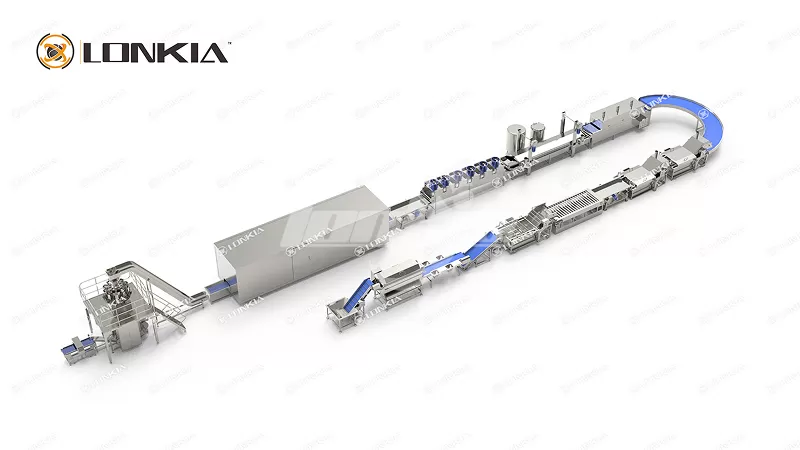
1. Typical Capacity of Small Scale Production Lines
Small frozen French fries production lines usually operate at:
| Production Capacity | Typical Factory Type |
|---|---|
| 50–100 kg/h | Startup workshops |
| 100–300 kg/h | Small commercial factories |
| 300–500 kg/h | Regional frozen food suppliers |
Energy and labor requirements increase as production capacity grows.
2. Main Energy Consumption Areas
The largest energy costs usually come from:
✔ Potato Washing & Peeling
Electric motors drive:
- Brush rollers
- Water pumps
- Conveyors
Power consumption is relatively low compared with frying and freezing systems.
✔ Blanching System
Blanching machines require:
- Electric heating
- Steam heating
- Gas heating
Steam systems are often more energy-efficient for continuous production.
✔ Frying Machine (Major Energy Cost)
The fryer is usually the largest energy-consuming machine in the entire line.
Energy sources:
- Electricity
- Gas
- Diesel
- Thermal oil heating
Continuous fryers:
✔ Better temperature stability
✔ Higher productivity
✔ Better energy efficiency in long operation
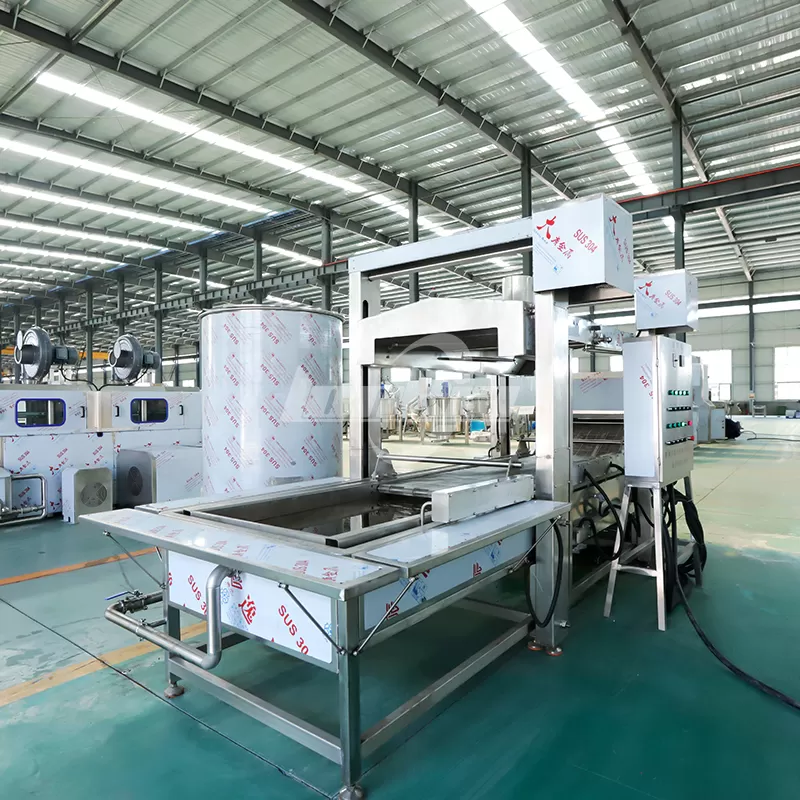
✔ IQF Freezing System (Highest Power Consumption)
The IQF freezer is typically the most electricity-intensive equipment.
Energy usage depends on:
- Freezing temperature
- Production volume
- Compressor efficiency
- Ambient factory temperature
👉 In many factories, freezing systems account for 30%–50% of total electricity usage.
✔ Packaging System
Packaging equipment consumes relatively low power but still contributes to total operational cost.
3. Estimated Energy Cost Reference
Below is a general reference for small-scale frozen French fries production:
| Capacity | Estimated Monthly Energy Cost |
|---|---|
| 50–100 kg/h | $800 – $2,000 |
| 100–300 kg/h | $2,000 – $6,000 |
| 300–500 kg/h | $6,000 – $12,000 |
👉 Actual cost depends heavily on local electricity and gas prices.
4. Labor Cost Analysis
Labor cost depends on:
- Automation level
- Production capacity
- Local salary standards
Semi-Automatic Line
Typical labor requirement:
- 5–10 workers
Workers handle:
- Feeding potatoes
- Sorting
- Packaging
- Manual transportation
Advantages:
✔ Lower equipment investment
Disadvantages:
❌ Higher labor dependency
Fully Automatic Line
Typical labor requirement:
- 2–5 workers
Automation reduces manual tasks through:
✔ Automatic conveying
✔ Automatic frying
✔ Automatic de-oiling
✔ Automatic packaging integration
Advantages:
✔ Lower long-term labor cost
✔ Stable production
5. Average Monthly Labor Cost
| Factory Type | Estimated Monthly Labor Cost |
|---|---|
| Small semi-auto line | $2,000 – $8,000 |
| Medium automatic line | $5,000 – $15,000 |
Labor costs vary significantly by country and region.
6. How to Reduce Energy Costs
✔ Use Energy-Efficient Fryers
Modern fryers improve heat utilization and reduce oil heating loss.
✔ Install Oil Filtration Systems
Cleaner oil improves heat transfer and reduces oil replacement frequency.
✔ Improve Factory Insulation
Better insulation lowers freezer energy consumption.
✔ Use Variable Frequency Drives (VFD)
VFD systems optimize motor energy usage.
✔ Optimize Production Scheduling
Continuous production is more energy-efficient than frequent start-stop operation.
7. How to Reduce Labor Costs
✔ Increase Automation
Automatic conveyors and packaging systems reduce manual work.
✔ Improve Factory Layout
Efficient layout reduces unnecessary labor movement.
✔ Train Operators
Well-trained workers reduce waste and downtime.
✔ Use Integrated Production Lines
Integrated systems simplify operation and maintenance.
8. ROI Consideration
Lower energy and labor costs directly improve profitability.
Factories with:
✔ Efficient fryers
✔ Optimized freezing systems
✔ Higher automation
usually achieve faster ROI and more stable long-term profits.
Conclusion
For small frozen French fries factories, energy and labor are two of the most important operating expenses.
Understanding:
✔ Frying energy consumption
✔ IQF freezer electricity demand
✔ Labor requirements
✔ Automation benefits
helps investors build a more profitable and sustainable production operation.
LONKIA – Energy-Efficient French Fries Production Solutions
LONKIA provides:
✔ Small scale frozen French fries production lines
✔ Energy-saving frying systems
✔ Efficient IQF freezing solutions
✔ Semi-automatic and fully automatic equipment
✔ Customized factory planning support
👉 Contact LONKIA today for a customized energy and labor cost optimized solution.