
Blanching is a critical step in industrial French fries production. The right blanching temperature can affect the color, texture, starch content, sugar reduction, and frying performance of the final product. For this reason, choosing the right French Fries Blanching Machine is just as important as selecting the correct processing temperature.
At LONKIA, we typically recommend a blanching temperature of approximately 70–85°C (158–185°F) for many industrial French fries applications. However, the optimal temperature depends on several factors, including potato variety, French fry size, blanching time, production capacity, and the desired characteristics of the final product.
What Is the Best Temperature for French Fries Blanching?
For most industrial French fries processing applications, 70–85°C (158–185°F) can be used as a practical blanching temperature range.
However, there is no universal temperature that is suitable for every production line. When selecting a French Fries Blanching Machine, we recommend considering temperature together with residence time, potato variety, strip dimensions, and downstream frying conditions.
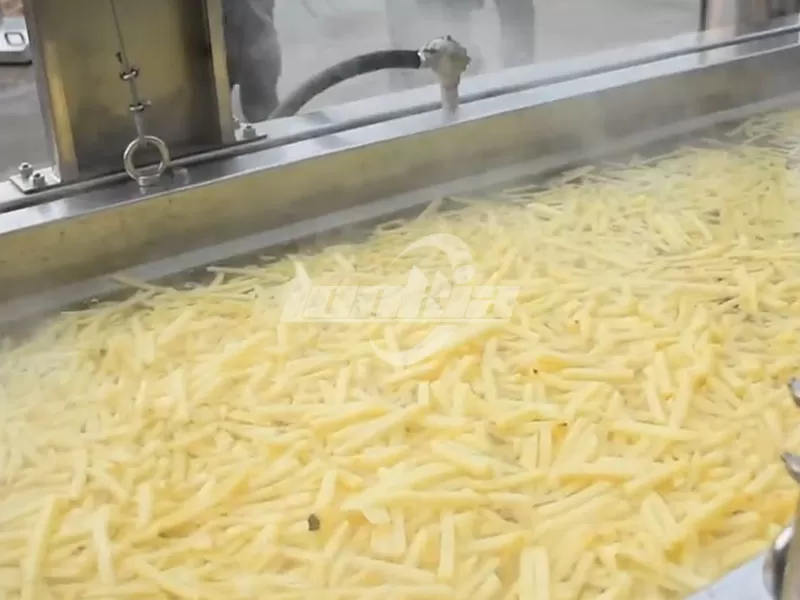
70–75°C: Gentle Blanching
Lower-temperature blanching can be suitable when the goal is to control surface starch and reducing sugars while maintaining the structure of the potato strips.
This range may be suitable for:
- Thin potato strips
- Certain potato varieties
- Products requiring a firmer texture
- Processing conditions where a longer blanching time is acceptable
75–85°C: Standard Industrial Blanching
This temperature range is commonly considered for commercial French fries processing because it can provide a good balance between starch modification, sugar control, texture, and processing efficiency.
At LONKIA, we recommend determining the final operating temperature according to the customer's raw materials and production requirements rather than selecting a temperature based only on machine capacity.
Above 85°C: Use With Care
Higher temperatures can accelerate heat transfer, but they also require precise control of blanching time. Excessive temperature or residence time may cause potato strips to become too soft and affect the final texture.
Therefore, increasing the temperature is not always the best way to increase production efficiency.
Why Is Blanching Important for French Fries?
Freshly cut potato strips contain surface starch and natural reducing sugars. If the strips are fried without appropriate blanching, they may develop uneven color, excessive browning, or inconsistent texture.
A properly controlled blanching process can help:
- Reduce excess surface starch
- Control reducing sugars
- Improve French fries color
- Partially gelatinize starch
- Improve texture consistency
- Reduce excessive browning during frying
- Prepare potato strips for subsequent processing
For frozen French fries production, blanching is particularly important because the product must maintain consistent quality after par-frying, freezing, storage, and final cooking.
What Is the Best Temperature for French Fries Blanching?
There is no single temperature that works perfectly for every French fries production line. However, 70–85°C (158–185°F) is a practical industrial range for many applications.
A typical process may use different temperature stages depending on the production requirements.
70–75°C: Gentle Blanching
Lower-temperature blanching can be suitable when the goal is to control starch and sugars while minimizing excessive softening of the potato strips.
This temperature range may be considered for:
- Thin potato strips
- Certain potato varieties
- Products requiring firmer texture
- Processing conditions where longer blanching time is acceptable
75–85°C: Standard Industrial Blanching
For many commercial French fries production lines, this range provides a good balance between starch modification, sugar control, texture, and processing efficiency.
At LONKIA, we generally recommend determining the final temperature based on the customer's potato variety, strip dimensions, throughput, and downstream frying process rather than selecting a temperature based on capacity alone.
Above 85°C: Use With Care
Higher temperatures can accelerate the blanching process, but they also require careful control of residence time. Excessive heat or overly long blanching can negatively affect the structure of potato strips and lead to an undesirable texture.
Therefore, simply increasing the temperature is not necessarily the best way to improve production efficiency.
Temperature Is Only One Part of the Blanching Process
When customers ask us about the best blanching temperature, we also look at blanching time.
Temperature and time work together. For example, a lower temperature may require a longer residence time, while a higher temperature can shorten the required processing time.
Other important factors include:
Potato Variety
Different potato varieties contain different levels of starch and reducing sugars. Their response to blanching can therefore vary.
French Fry Size
A 7×7 mm strip and a 10×10 mm strip do not require exactly the same processing conditions. Thicker strips generally require more time for heat to penetrate the product.
Desired Final Product
The optimal process can also differ between:
- Frozen French fries
- Fresh-cut French fries
- Fully cooked fries
- Par-fried frozen fries
Production Capacity
A large industrial line requires stable control of product residence time and water temperature. The blancher must be designed according to the required throughput rather than simply scaled up from a small machine.

How Does Industrial French Fries Blanching Work?
In a typical industrial French fries production line, blanching takes place after cutting and washing.
The general process is:
Potato Receiving → Washing → Peeling → Cutting → Washing → Blanching → Dewatering → Drying → Frying → Deoiling → Freezing → Packaging
After the potato strips enter the blanching machine, hot water transfers heat to the product. The potato strips remain in the blancher for a controlled period before moving to the next processing stage.
At LONKIA, we can configure the blanching system according to the complete production process instead of treating the blancher as an isolated machine.
How Do You Know If the Blanching Temperature Is Correct?
Temperature alone cannot determine whether blanching is successful. We recommend evaluating the finished French fries through several indicators.
Color
Proper blanching helps produce a more uniform golden color after frying. Excessive browning may indicate that the process needs adjustment.
Texture
The fries should have the desired internal softness while maintaining sufficient structural integrity.
Frying Performance
Properly blanched potato strips should fry consistently and achieve the required appearance and texture.
Product Uniformity
For industrial production, consistency from batch to batch is critical. Temperature, residence time, water circulation, and product loading should remain stable.
Should You Use One Blanching Temperature or Multiple Stages?
For some industrial applications, a multi-stage blanching process can provide better process control than using a single temperature.
For example, different stages may be used to gradually heat the potato strips and achieve the desired starch and sugar control. The exact configuration depends on the potato raw material and final product requirements.
For high-capacity French fries production, we recommend considering the blancher together with the cutting, drying, frying, freezing, and conveying systems. This allows the entire production line to operate more consistently.
LONKIA's Approach to French Fries Blanching
At LONKIA, we do not recommend choosing a blanching temperature based on a single standard number.
Before selecting the blanching system, we consider:
- Potato variety
- Raw potato quality
- French fry dimensions
- Required production capacity
- Target frying color
- Desired texture
- Blanching time
- Heating method
- Water circulation
- Downstream frying and freezing conditions
Based on these factors, we can help customers determine a suitable blanching process and configure the corresponding industrial equipment.
Our French fries processing solutions can be designed for different production capacities, from smaller commercial operations to large-scale industrial processing plants.
Final Thoughts
So, what is the best blanching temperature for French fries?
For many industrial applications, 70–85°C (158–185°F) is a useful starting range. However, the ideal temperature cannot be determined independently from blanching time, potato variety, strip size, and final product requirements.
A well-designed blanching process can help improve French fries color, texture, consistency, and frying performance. For this reason, we recommend optimizing the complete processing system rather than focusing on temperature alone.
If you are planning a French fries production line or need help selecting an industrial blanching machine, LONKIA can evaluate your potato variety, target capacity, fry size, and processing requirements to recommend a suitable solution.